
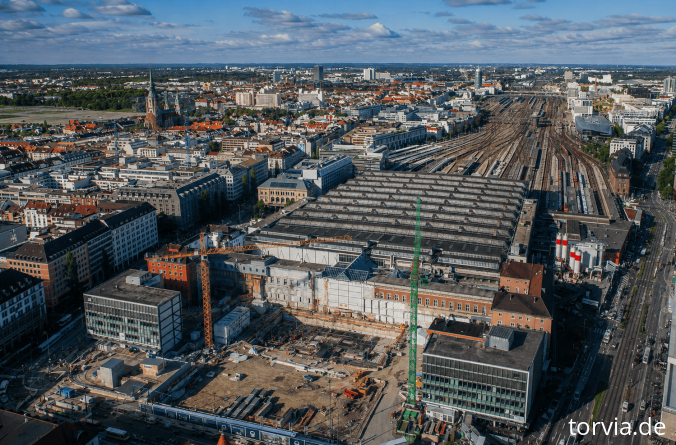
City in Transition: More Than Just New Buildings
It is not just individual major projects like the 2nd S-Bahn main line or the new district of Freiham that are changing the face of Munich. Across the entire city area, traffic corridors are being renovated, schools and daycare centers are being expanded, and infrastructure is being adapted to the growing population.
„We are not just building for today, but for the coming decades. The goal is to combine quality of living, mobility, and climate protection.“
For executing construction companies and subcontractors, high investment activity in the public sector provides a continuous order volume. However, tight inner-city space constraints and strict noise control regulations require innovative logistics concepts and the use of low-emission construction machinery.
Overview of Selected Major Projects
| Project Focus | Target Timeline | Key Technology / Concept | Volume |
|---|---|---|---|
| 2nd S-Bahn Main Line & Central Station | Infrastructure Core Phase 2027 | Specialist Foundation Engineering, Tunnel Boring | approx. €3.8 billion |
| Neufreimann Climate District | 1st Construction Phase (Residential) | Recycled Concrete, District Heating, Timber Construction | approx. €1.2 billion |
| School Construction Offensive Phase IV | Completion of 18 Units | Modular Construction, Serial Building | approx. €850 million |
| Digital Twin & BIM | Citywide Standard | 3D Spatial Data, Cloud BIM | 100% Mandatory for Municipal Buildings |
.png)
Sustainability Becomes the Standard
Environmentally conscious construction has long ceased to be an option—it is now mandatory. Neighborhoods such as Neufreimann or Ramersdorf are planned as "climate districts": utilizing recycled concrete, timber-hybrid construction, and green energy concepts. Through "urban mining," old building materials are reused, saving up to 90 percent CO₂ compared to new production. These topics will also take center stage at BAU 2027 in Munich—serving as a blueprint for the entire industry.

Digitalization: Construction 4.0
Planning, controlling, documenting—everything is becoming digital. With Munich’s "Digital Twin," construction measures can be virtually reviewed and coordinated before the ground is even broken. BIM models ensure that architects, engineers, and construction companies always access the same data—saving time, preventing errors, and lowering costs. Building permit applications are also handled almost entirely online today. This opens up new opportunities for companies, especially if they adopt modern technology early on.
Market Analysis for Subcontractors & Specialist Contractors
Due to the City of Munich’s transition to digital building permits and mandatory BIM standards for municipal tenders, digitally connected construction companies are experiencing clear competitive advantages along with faster acceptance and payment processes.
An Industry in Transition
The construction industry is stabilizing in 2026/2027: interest rates have leveled off, and material prices are less volatile. However, the shortage of skilled labor remains the biggest challenge. New approaches through digital networks, further training, and promoting young talent are required. Pressure remains high, particularly in residential construction, while fiber-optic expansion, energy-efficient renovations, and converting commercial space into housing are opening up new contracts.
Conclusion and Outlook
Munich is and remains one of Europe’s largest construction sites while simultaneously serving as a pioneer in the future of building. Those who recognize the signs of the times and focus on sustainability, digitalization, and strong collaboration stand to benefit from this momentum. The course for 2027 and beyond has been set: modern, livable, and future-proof—that is how the city aims to grow for years to come.